

Essays on philosophical inquiry, cognition, decision-making, energy work and neuroscience.
When Thinking Through It Isn't Enough
When Thinking Through It Isn't Enough
Integrating Thinking, Feeling, and Willing into Coherent Action
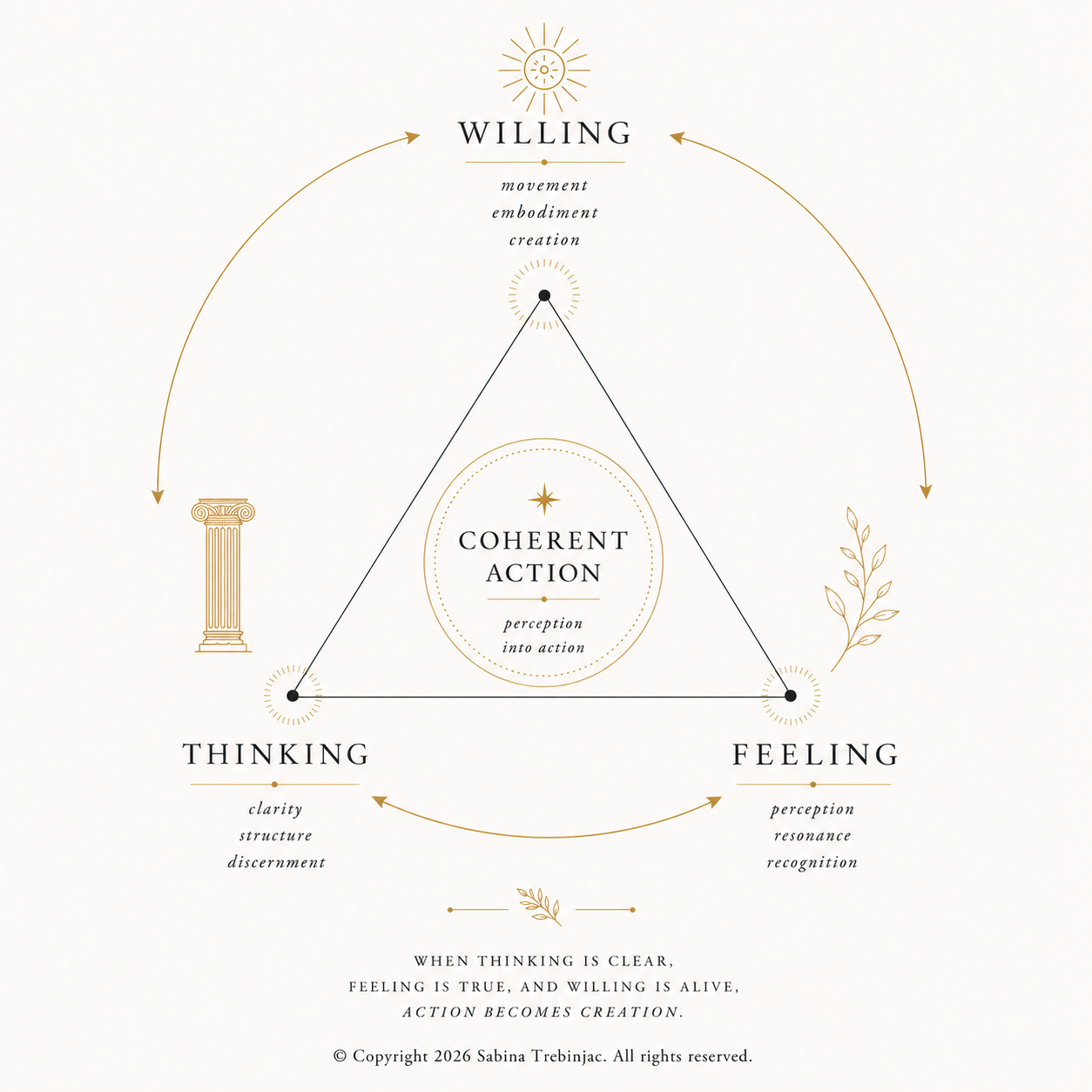
Visionary decision-making lights up when thinking, feeling, and willing are consciously integrated.
Today, we are taught to think logically. In fact, this begins when we are very young, before the brain has even had a chance to develop executive function in the mid-20s. With logic, we are promised an anchor through the stormy seas of life, like a North Star that will always show the way through the clouds with certainty and will never abandon us. And we are interested in finding our North Star, because unlike an Ikea bookshelf, life is not handed to us neatly with a user manual along with this Earth Life Package. This issue becomes even more important with the onslaught of information we have available to us, and often, misinformation also muddies the waters. The issue has most recently progressed to exponential proportions, with artificial intelligence acting as a pseudo-decision-making machine to help us navigate the vastness of this information, which our ancestors never had to navigate. But is “thinking through it” enough as the most effective path to decision making?
Research offers a clue. In fact, optimal decisions integrate something more akin to a sharpened instinct. Instinct should then be refined by clarity of thought and discernment. And willing into our thinking and feeling brings the insight into a real creation. The instinct component of our decision making is counterintuitive based on what we are taught, but perhaps that model is incomplete.
This historical preference for logic above instinct signified a turning point in decision-making, taking humans from seemingly impulsive decision makers into what was believed to be a refined objectivity. The development of the principles of reasoning and formal proof began with Greek thought, and during that time culminated with Aristotle. These developments were important and lay the basis for future expansion and the foundation for science and rational analysis.
The main challenge for modern consciousness is integration of clear thinking, living feeling and conscious will. This integrated approach guards against losing ourselves either in impotent abstraction or exuberant irrationality, at the end of the day, wholeness in decision-making is essential. Philosopher and esotericist Rudolf Steiner laid out meditative protocols for the integration of the willing, thinking, and feeling components of human consciousness. In psychology, psychiatrist Dr. Paul Conti describes an aggressive drive, pleasure drive, and generative drive, which also addresses the balancing of feeling and willing components, and the drive to build, create, and learn that leads to a sense of achievement and contentment in every human.
Dysfunction occurs when either some, or all of willing, thinking, and feeling become fragmented, disconnected, suppressed or conversely, overdeveloped. These do not need to be balanced in an equal way, but harmoniously integrated. Unbridled will without clear thinking and feeling become violence and abuse of power. Feeling without will and clear thinking becomes mania, addiction, loss of boundaries, cult following, fanaticism. Thinking without will and living feeling becomes impotent abstraction, apathy, isolation, existential meaninglessness, stagnation, disconnection from our mission.
In the early stages of life, the thinking, feeling and willing processes are more automatic. We move through life with automatic sympathies and antipathies, as a response to our environment. This has evolved in a way to optimize survival and reproduction. However, as development of consciousness takes place in a way that will is able to take hold of the feeling and thinking processes, some of the automatic processes begin to become interrupted. With increased mastery over our faculties, comes the requirement of higher responsibility but also higher freedom. As will is brought in, we can separate out the thinking, feeling and bring it back together in a conscious way. Bringing thinking, feeling, and willing back together creates the foundation for conscious creativity, vision, leadership, relationships, and a sense of internal wholeness. This process of transformation of the thinking and feeling capacities allows a robust connection to this internal guidance system referred as the True Self or Higher Self.
The molecular mechanisms of willing, feeling, and thinking systems are also biologically interconnected. We don’t 1) think, 2) separately feel, 3) separately act. The system is deeply integrated. One example is dopamine, the molecule popularly known for pleasure, is actually involved in the movement towards the thing we want and the pleasure derived from getting it. In fact, dopamine is involved in motivation, mechanical movement, reward/risk prediction, learning from mismatches, and novelty.
Parkinson’s disease is an example of the effects of a dopamine deficit. By the time Parkinson’s disease is diagnosed, a substantial proportion of dopamine neurons have already been lost. The movement deficits are most obvious first. However, dysregulation of pleasure, motivation, and emotional tone also occurs. More significant cognitive effects are observed later and more variably, including executive function, working memory, and cognitive flexibility.
In ancient times, humans were likely more connected to their instinctual, creative and spiritual faculties, however, that setup does not lend itself to the development of a stronger purified will. It is necessary for the mastery of the internal state and a meaningful relationship with the outside world arise out of an integrated approach in which our own will, thinking and feeling need to be intimately involved in the process.
Each layer of integration clears a layer of fragmented interference that obscures the clear lens and channel to our inner knowing, connecting us more closely to our Higher Self. True mastery of the internal state gives rise to wholeness, leadership, courage, freedom, creativity, awe, and more moments of internal peace. If fragmentation between thinking, feeling, or willing contributes to confusion, paralysis, and misalignment, the next question is obvious: How do we begin that integration process?
Next, we will delve deeper into all three of the faculties, some of the interesting research around instinct in decision making, and the many tools for part or the whole of the integration process.
Further Reading:
Bechara A, Damasio H, Tranel D, Damasio AR. Deciding Advantageously Before Knowing the Advantageous Strategy. Science. 1997 Feb 28;275(5304):1293-5.
Conti, Paul. What's Going Right: A Powerful New Method for Optimizing Your Mental Health. May 5, 2026.
Steiner, Rudolf (1861-1925). How to Know Higher Worlds. (C. Davy & A. Meuss, Trans.). Anthroposophic Press. (Original work published 1904–1905)